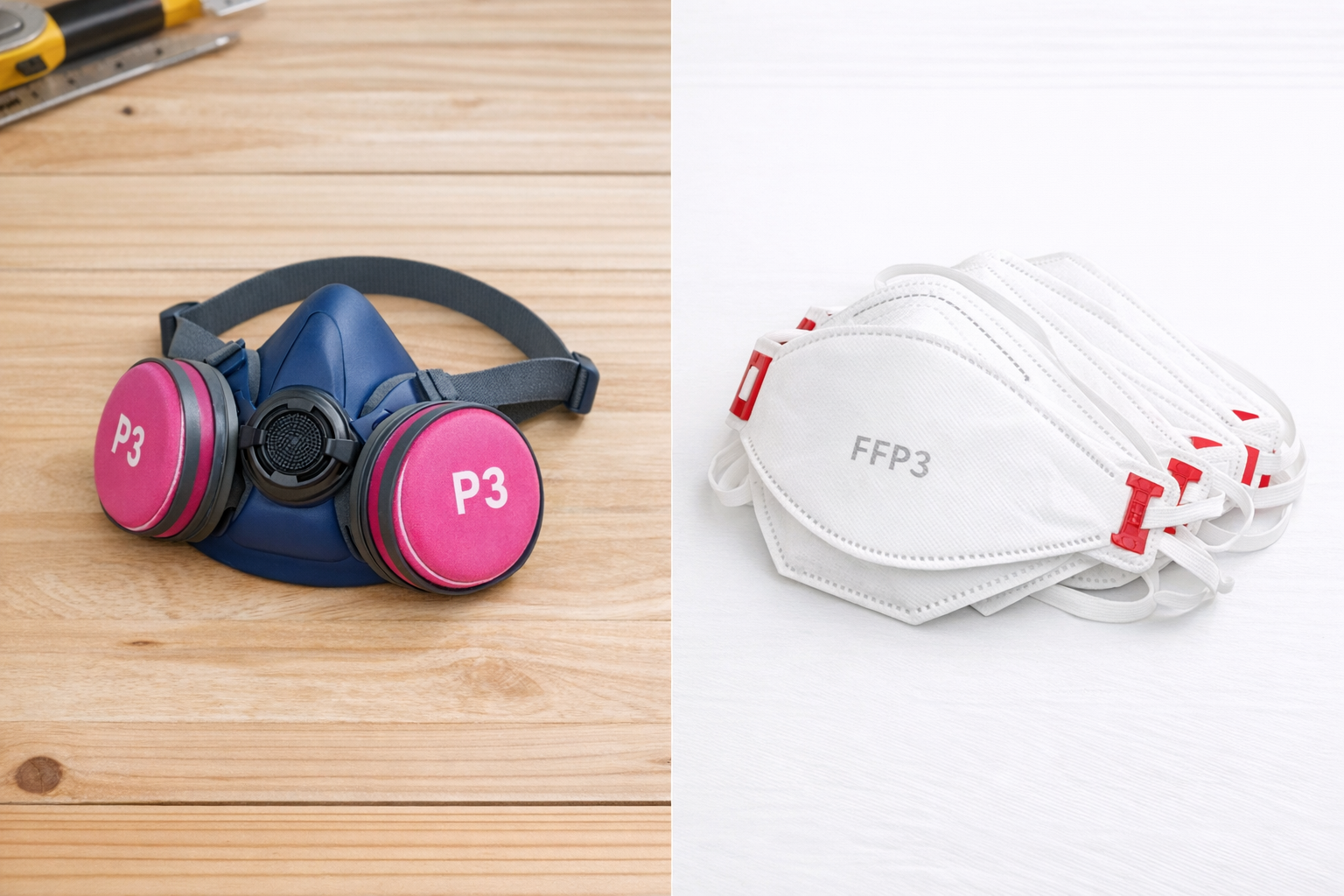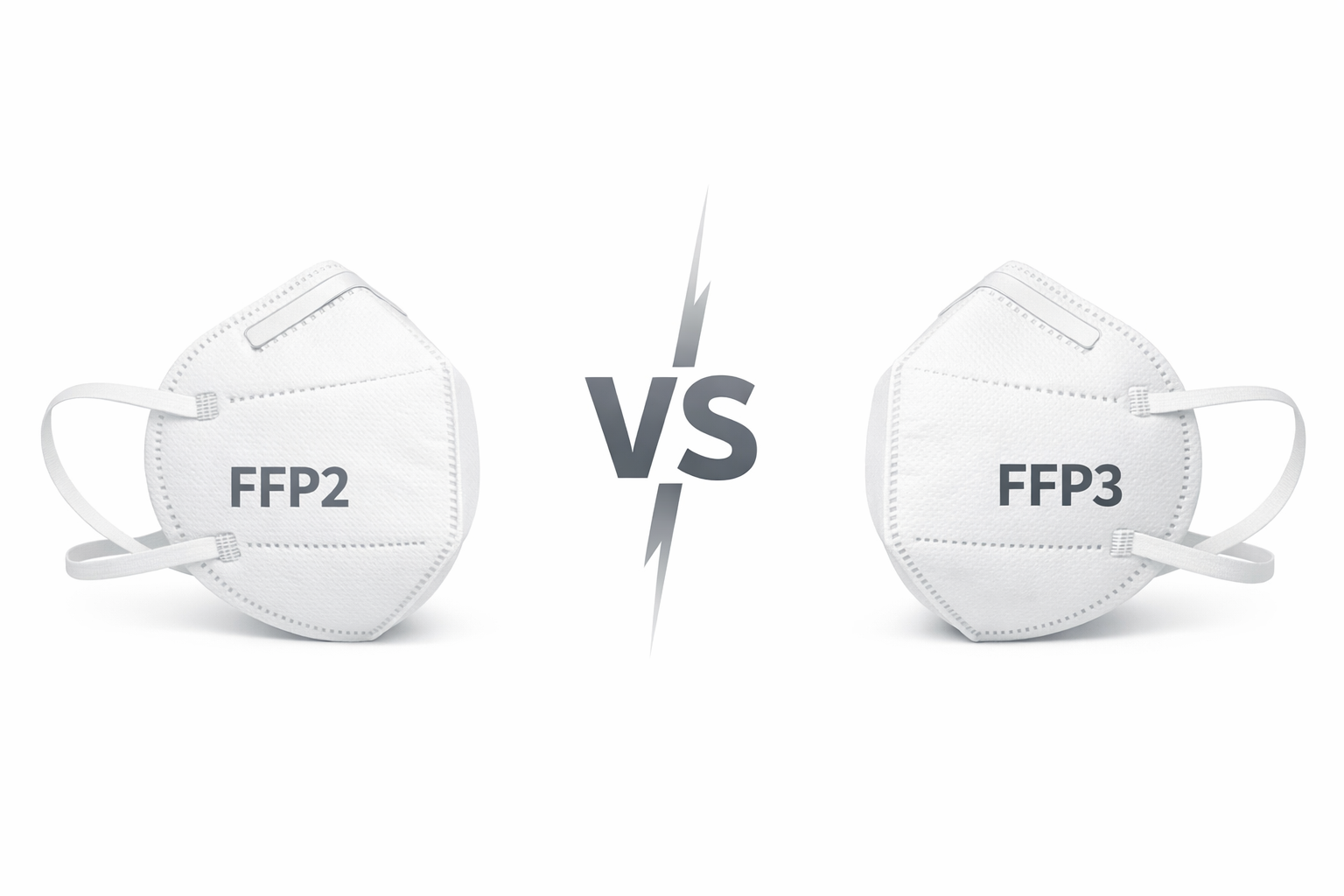
It's the most common question in respiratory protection: do I need FFP2 or FFP3? The short answer is that it depends on what you're protecting against — and for many common tasks, FFP2 is not only sufficient but actually the better choice.
This guide explains the real differences, when UK law requires one over the other, and how to avoid overspending on protection you don't need.
The Technical Difference in 30 Seconds
| FFP2 | FFP3 | |
|---|---|---|
| Minimum filtration | 94% of airborne particles | 99% of airborne particles |
| Maximum inward leakage | 8% | 2% |
| Assigned Protection Factor | 10x (reduces exposure by factor of 10) | 20x (reduces exposure by factor of 20) |
| Breathing resistance | Lower — easier to breathe through | Higher — noticeably harder |
| Standard | EN 149:2001+A1:2009 | EN 149:2001+A1:2009 |
| Face-fit test required? | Yes (for workplace use) | Yes (for workplace use) |
| Typical price per mask | £0.50 – £6.25 | £0.10 – £7.96 |
Both are tested to the same European standard (EN 149). Both require face-fit testing for workplace use. The difference comes down to how much of the hazardous substance they keep out.
What the Numbers Actually Mean
Assigned Protection Factor (APF)
The HSE uses Assigned Protection Factors to determine which RPE (Respiratory Protective Equipment) you need. An APF of 10 means the mask reduces the concentration of airborne particles you breathe by a factor of 10. An APF of 20 means by a factor of 20.
- FFP1: APF 4 (reduces exposure 4x)
- FFP2: APF 10 (reduces exposure 10x)
- FFP3: APF 20 (reduces exposure 20x)
The key insight: you only need FFP3 if your workplace exposure exceeds 10x the Workplace Exposure Limit (WEL). If exposure is below 10x the WEL, FFP2 provides legally adequate protection.
Filtration: 94% vs 99%
The difference sounds dramatic — but consider what it means in practice. FFP2 lets through a maximum of 6% of test particles. FFP3 lets through 1%. Both numbers are tested against particles of 0.4 microns (sodium chloride aerosol), which is far smaller than most workplace dusts.
For context: wood dust particles are typically 10-30 microns, construction dust is 1-100 microns, and pollen is 10-40 microns. At these sizes, both FFP2 and FFP3 filter essentially 100% of particles. The difference only matters for very fine aerosols and at very high concentrations.
When UK Law Requires FFP3
The HSE specifies FFP3 (or equivalent) for certain hazards where the Assigned Protection Factor of 10 (FFP2) isn't sufficient. These include:
Mandatory FFP3 Situations
- Asbestos work — FFP3 is the minimum for any work with asbestos-containing materials. No exceptions.
- Welding fumes — Since 2019, all welding fumes (including mild steel) are classified as carcinogenic. HSE requires FFP3 as minimum for welding up to 1 hour; powered respirator for longer periods.
- Silica dust above 10x WEL — The WEL for respirable crystalline silica is 0.1 mg/m³. If exposure exceeds 1.0 mg/m³ (10x WEL), FFP3 is required.
- Lead dust and fume — FFP3 for lead work where exposure is significant
- Healthcare infection control — FFP3 required for aerosol-generating procedures with patients known or suspected to have airborne infections (TB, COVID-19, measles, etc.)
Where FFP2 Is Sufficient
- General construction dust — Brick cutting, concrete drilling, sanding (where exposure is below 10x WEL)
- Wood dust — Sawing, sanding, routing (WEL is 3 mg/m³ for softwood, 5 mg/m³ for hardwood)
- Painting and decorating — Spray painting (with appropriate organic vapour protection if needed)
- Hay fever and pollen — FFP2 is scientifically proven to eliminate pollen symptoms (see our hay fever guide)
- General cleaning and dusty environments
- Agriculture — Grain dust, animal dander (at typical exposure levels)
The Comfort Factor (Don't Underestimate This)
Here's something the spec sheets don't tell you: FFP3 masks are noticeably harder to breathe through.
The EN 149 standard sets maximum breathing resistance limits:
| Class | Inhalation resistance (at 95 L/min) | What it feels like |
|---|---|---|
| FFP2 | Max 2.4 mbar (240 Pa) | Noticeable but manageable |
| FFP3 | Max 3.0 mbar (300 Pa) | Heavy — like breathing through a thick cloth |
That 25% increase in breathing resistance matters, especially during physical work. Workers wearing FFP3 masks for extended periods report more fatigue, more frequent mask adjustments (breaking the seal), and lower compliance — they're more likely to pull the mask down or take it off entirely.
A well-fitted FFP2 you actually wear all day provides better real-world protection than an FFP3 you keep pulling down because you can't breathe.
Face-Fit Testing: Same for Both
Both FFP2 and FFP3 masks require face-fit testing for UK workplace use. This isn't optional — the HSE mandates it under COSHH regulations. A fit test checks that the specific make and model of mask forms an adequate seal on your face.
Key facts:
- Around 20% of people fail their first fit test with any given mask
- Different brands and shapes suit different faces — if you fail one, try another
- Fit testing must be repeated if you change to a different mask model
- Facial hair (even stubble) will cause a fail — the mask needs clean-shaven skin to seal
This means the mask's protection factor is only achieved after a successful fit test. Buying FFP3 without fit testing gives you no guaranteed advantage over FFP2.
NR vs R: Single-Use vs Reusable
You'll see "NR" or "R" after the FFP class on every mask. This refers to reusability:
- NR (Non-Reusable) — Designed for a single work shift (up to 8 hours). Discard after use.
- R (Reusable) — Can be used across multiple shifts. Must be cleaned and stored properly between uses.
Most disposable masks are NR. If you need daily protection, the maths often favours reusable half-mask respirators with replaceable P2 or P3 filters — particularly for FFP3 use where disposable mask costs add up quickly.
The "D" Designation
Some masks show a "D" after NR or R (e.g., "FFP3 NR D"). This means the mask has passed the dolomite clogging test — it maintains acceptable breathing resistance even after prolonged use in dusty conditions. If you work in heavy dust, look for the D designation.
Price Comparison: FFP2 vs FFP3
Here's what you'll actually pay, with current best prices from UK suppliers:
Cheapest FFP2 Masks
| Mask | From (per mask) | Suppliers |
|---|---|---|
| JSP F621 Flat Fold | £0.50 | 1 |
| Oxyline XR 250 | £1.00 | 2 |
| 3M Aura 9320+ | £1.38 | 13 |
Cheapest FFP3 Masks
| Mask | From (per mask) | Suppliers |
|---|---|---|
| 3M Aura 9332+ | £0.10 | 19 |
| Alpha Solway HX-3 | £0.11 | 4 |
| GVS Segre F31000 | £0.88 | 1 |
| Honeywell SuperOne 3207 | £3.00 | 1 |
The cheapest FFP3 masks (from £0.10 in bulk) are actually cheaper than many FFP2 options. Bulk pricing and competition between suppliers means that even 3M Aura FFP3 masks can cost less per unit than budget FFP2 options — especially in larger quantities.
So Which Do You Need? The Decision Tree
- Working with asbestos? → FFP3 (minimum). No exceptions.
- Welding? → FFP3 for up to 1 hour. Powered respirator for longer.
- Know your Workplace Exposure Limit? → If exposure is under 10x WEL: FFP2. Over 10x WEL: FFP3.
- Healthcare aerosol-generating procedures? → FFP3.
- General construction dust, wood dust, DIY? → FFP2 is sufficient.
- Hay fever or pollen? → FFP2 is more than enough.
- Not sure? → Get a COSHH assessment done. Your employer is legally required to assess workplace exposures and determine the correct RPE.
The bottom line: FFP3 isn't "better" in any absolute sense — it's designed for higher-risk situations. For the majority of everyday dust, pollen, and general construction work, FFP2 provides legally adequate and scientifically proven protection, with better comfort and lower cost.